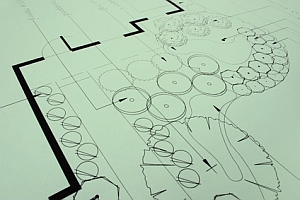
Planning Landscaping - Plot Plan© David Alan Carter Let’s cover some basics of the plot plan –your first step in planning landscaping. Graph Paper Is Your FriendUse it to prepare an accurate plot plan of your property. Typically, a scale of either 1/8 or 1/4 inch equals one foot should work. Using such a scale, outline your property line and draw in all existing structures–house, driveway, existing patios and walkways, walls and fences, trees and shrubs. Mark the doors and windows in your plot plan sketch of the house–they will impact the positioning of plantings. Don’t forget overhead power lines (they will impact your decision on the height of plantings in that area), underground utilities (you do not want to dig up your gas line, nor do you want to place a willow tree on top of a water line) and easements. Last but not least, make a note of drainage flow–if that’s an issue on your property–as well as prevailing winds, east-west orientation, and any preferable view beyond your property (i.e., you might want to hide the neighbor’s rusting shed with evergreens along your northern property line, but leave the southern view wide open to take advantage of a distant cityscape). Now, ExperimentNow it’s time to add your ideas for landscaping to the plot plan. But don’t ruin the plot plan you just took an hour to graph out. Take that plot plan and either Xerox it 15 times and work on the copies (you’ll go through that many trials and errors), or use tracing paper to lay over the plot plan and work your magic on the tracing paper. Either way, now you can let your imagination run. Begin by focusing on use areas–a lawn for play, a vegetable garden for the infamous home-grown tomato, a patio or deck for outdoor living, maybe a fenced dog run to give King his own space and keep him from upending Great Aunt Ethel sipping sweet tea on the patio for outdoor living. How Do You Want To Move To--And Through--Your Landscaping?Do you need a path from the curb to the front door? From the front drive to the backyard? Do you want both sides
of the house accessible to the back? Straight or circuitous path to the garden from the back door? Where do you
need privacy? Does a prevailing wind require a wind block? As the sun arcs across the sky from east to west, how
would you like to take advantage of it–both summer and winter? For example, a deciduous redbud or mimosa planted on
the southern edge of a proposed patio will keep the area shaded in the summer, yet allow the sun to stream through
leafless branches in the winter. Thinking about a reflecting pool nearby? Or have Bring It All HomeAs you begin to visualize yourself in the landscaping, sketch in the hard surfaces–the fences, the walkways, the paving and decking. You’re almost there. Now take those doodled flower beds and areas marked “planting” and tag what uses the plants are to serve. Shade? Aesthetics? Erosion control? Privacy screen? Delectable edibles? Aroma therapy? Plants grow–so factor in the mature size of trees and shrubs when calculating space parameters. Okay–time to begin making some tentative selections of actual plants from plant lists catalogued to your area’s climate zone. Recommendation Alert! If you prefer working with your computer over graph paper, look into
Better Homes and Gardens Landscaping and Deck Designer 8.0 [Newest Version] The previous version,
Better Homes and Gardens Landscaping and Deck Designer 7.0 [Old Version] Where do we go from here? Review the 5 key elements in crafting a space that aesthetically pleases and transports you in Planning Landscaping - Landscape as Art. David Alan Carter is a homeowner, budding landscaper and freelance writer who lives each of his articles–and has the aching back and purple thumb to prove it.
| |||||||
Navigation: My 3 Mistakes > The Plot Plan
|
 an aversion to sweeping? Okay–scrap the mimosa (the mid-summer feathery
blooms are very messy) and consider dogwood or river birch. Now you’re working it.
an aversion to sweeping? Okay–scrap the mimosa (the mid-summer feathery
blooms are very messy) and consider dogwood or river birch. Now you’re working it. . This is a
powerful software package from the trusted folks at Better Homes and Gardens that puts every imaginable tool
at your fingertips for designing outdoor projects from landscaping to decks and patios, sprinkler systems,
water features, etc. You can import your own photos, choose and arrange plants from a catalog of over 3500,
and estimate project costs. This is great stuff for experimenting with design ideas--see what a
single or multi-level deck would look like coming off your back door; see what a brick or stone patio would
look like before you break your back; build fencing and arrange outdoor furniture in 3D graphics.
. This is a
powerful software package from the trusted folks at Better Homes and Gardens that puts every imaginable tool
at your fingertips for designing outdoor projects from landscaping to decks and patios, sprinkler systems,
water features, etc. You can import your own photos, choose and arrange plants from a catalog of over 3500,
and estimate project costs. This is great stuff for experimenting with design ideas--see what a
single or multi-level deck would look like coming off your back door; see what a brick or stone patio would
look like before you break your back; build fencing and arrange outdoor furniture in 3D graphics. , is nothing to
sneeze at. It includes the exclusive Better Homes and Gardens Plant Encyclopedia and Plant Hardiness Zone
Reference maps. Amazon has it for a good price and it ships free.
, is nothing to
sneeze at. It includes the exclusive Better Homes and Gardens Plant Encyclopedia and Plant Hardiness Zone
Reference maps. Amazon has it for a good price and it ships free. 
 Back To
Top
Back To
Top
|
PlanningLandscaping.com
Your growing online source for landscape
planning -- from the sketch pad of garden plans and
outdoor structures, to plant selection, planting tips,
and thoughts and recommendations on outdoor
furnishings.
© Copyright 2008 - Present, Webstreet Properties. All Rights
Reserved.