Planning Landscaping - Landscape As Art© David Alan Carter We covered the functionality of landscaping in Planning Landscaping - Plot Plan, but it bears mentioning that landscape is more than function. It’s also art. Any bit of color or design can be framed and hung on the wall and it will function as a painting, though it might not be art. In a similar vein, a lawn may function as outdoor space, but not space that aesthetically pleases or transports you. Part of planning landscaping is transforming a sow’s ear into a silk purse. We should keep in mind a few things... Keep It SimpleIn planning landscaping, you don’t need to flesh out every imaginative thought you’ve ever had when it comes to your yard, nor do you need to buy every plant in the nursery. A flowerbed with 50 different plants fighting for attention will fail to please the senses. Rather, think in terms of clusters (of color, texture and size), one flowing gently into the other. Work toward landscape unity--a sense that everything belongs together--by repeating common landscape elements. Love small junipers? Maybe an Arcadia Juniper? You might cluster three at one end of the patio, then repeat them along a path to a second cluster at the path’s end, effectively tying one area of the yard with another. Unity. A panoramic scan of your yard should remain easy on the eye with no discordant themes. Two or three patters/textures/colors repeated throughout a landscaping is more pleasing to the eye than chaos and rainbows everywhere you look. Speaking of everywhere you look, if you've looked everywhere for that certain special plant, don't give up 'till you've tried Nature Hills Nursery, Inc. They're a good source of hard-to-find container plants shipped worry-free to your door. Keep It BalancedBalance is a basic principle in art. Landscape balance means creating the same visual weight on either side of a center of interest. Keep in mind that balance is not the same as symmetry. If you wish the center of interest in your backyard to be a water garden, then balance would suggest the large tree to the left of the garden be offset by two smaller trees to the right–to keep the eye focused on the garden. From the curb, if you wish the travelers’ eye to focus on a magnificent front entry, then a Japanese Maple of vibrant reds to one side of that entry might need to be offset by something equally compelling to the other side–otherwise the maple catches and keeps the eye. As we see, landscape balance is not limited to size of mass–it can be color, texture or form. Keep It ProportionedIn planning landscaping, select plants whose mature size will remain in proportion to the house and related
structures. I love the Colorado Blue Spruce, but the diminutive size of my home drop-kicks any thought of
FYI, if a particular tree is hard to come by in your area, you'll find over 150 species here. Tie The Yard To The HouseTake stock of the construction materials that make up your house and keep them in mind when planning landscaping
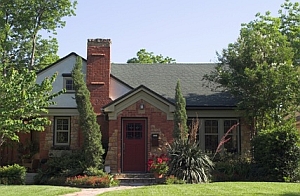
- foliage, as well as hard structures. Are the paving stones you’d like for the patio going to clash with the brick
on the house? Can you find a better match, or would a wooden, ground-level deck be more fitting to your home?
Speaking of which, is your home an English Beware Of BlingUnless your garden’s theme is 50's kitsch, even a single plastic pink flamingo is probably overkill. I say that with apologies to all owners of pink flamingos, not to mention owners of gargoyles guarding the gates, fairies alighting atop butterfly bushes, shiny balls on garden pedestals and Tiki torches lighting every step along every path from street to garbage can. Now don’t get me wrong, I like a good Tiki torch now and then. Especially when I need to see at night to avoid those dang gargoyles. And some Garden Fountains and statuary you’re actually going to find on our website–‘cause I like’em. What I'm really trying to say is keep an eye on the overall theme. And remember that a little bling goes a long way. Try slipping your old high school ring on the same finger with your wedding band, and you’ll see what I mean. P.S. That said, I love this old fellow, the
Carruth 111 Garden Smile Plaque David Alan Carter is a homeowner, budding landscaper and freelance writer who lives each of his articles–and has the aching back and purple thumb to prove it.
| |||||||
Navigation: My 3 Mistakes > Landscape As Art
|
 planting such an animal (they can reach a height of 60-70 feet).
Conversely, if you own large two-story, a single dwarf burning bush on the corner will look lost. Sidebar: The
concept of 'mature size' is worth keeping the forefront of your mind as you plan.
planting such an animal (they can reach a height of 60-70 feet).
Conversely, if you own large two-story, a single dwarf burning bush on the corner will look lost. Sidebar: The
concept of 'mature size' is worth keeping the forefront of your mind as you plan. 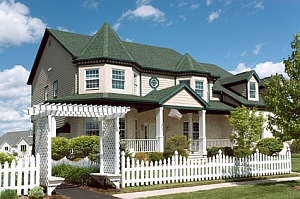 cottage or a modern masterpiece? The answer might dictate whether
white-washed pickets or a solid fence of overlapping, horizontal boards would be more appropriate.
cottage or a modern masterpiece? The answer might dictate whether
white-washed pickets or a solid fence of overlapping, horizontal boards would be more appropriate. .
.
 Back To
Top
Back To
Top
|
PlanningLandscaping.com
Your growing online source for landscape
planning -- from the sketch pad of garden plans and
outdoor structures, to plant selection, planting tips,
and thoughts and recommendations on outdoor
furnishings.
© Copyright 2008 - Present, Webstreet Properties. All Rights
Reserved.