Planning Landscaping... Avoid My 3 Mistakes© David Alan Carter One year after hastily planting upwards of 50 shrubs, trees and assorted leafy green whatnots in the barren yard
of the house we just bought, I was 1) Have A PlanI figured, nature doesn’t have a plan. Why do I need one? Well, it turns out nature does have a
plan--survival of the fittest. The strong overtake the In planning landscaping, start with a paper and pencil sketch. Outline your lot, home and driveway, and begin doodling some ideas. Sketch out flowerbeds–do you want curved, flowing boundaries or crisp, formal lines and angles to the beds? Freestanding clusters of shrubs, grasses and flowers–where? And trees–evergreen or deciduous, standing alone or clustered or incorporated into a bed? Need some ideas? Need to see how others have made planning landscaping work for them? Take a drive and pick out yards that you find especially well landscaped–take notes or even pictures. Hint:
leave the telephoto lens at home to avoid neighbors calling 911. Better yet, ask permission of the homeowner first.
You’ll likely get permission, a Find more ideas in planning landscaping from books and magazines. Since my early fiasco, I’ve taken to
clipping photos from magazines and have amassed a collection of self-help landscaping books from the likes of Home
Depot and Lowes and Amazon.com, providing not only relevant photographs and in-depth planning guides, but critical
help in identifying individual plants for your climate zone and preferred level of maintenance. Of these,
Step-by-Step Landscaping (Step-By-Step) Prefer software? Look into
Better Homes and Gardens Landscaping and Deck Designer 8.0 [Newest Version] But I digress. In sum, have a plan, or have a shovel in your hand for the next five years. 2) Don’t Crowd Those New PlantsEvery container plant from your favorite nursery or garden center will have attached a little plastic tag
identifying the plant and offering planting suggestions. Treat those suggestions as gold. Especially the spacing
suggestions. To wit, the three Blue Pfitzer junipers purchased by yours truly and spaced two feet apart in a front
flower bed when the tags said to space them 5-6 feet apart. My thinking was: but they’re so tiny. And they looked ridiculously tiny in that big old empty flower bed. So I
pushed them together and two years later I was digging up the middle one and planting it further out and two years
after that I was I wish I could say that the junipers were the only plants on which I ignored the spacing requirements. Sadly, in my zeal to fill up a yard I ignored tags left and right. Which accounts for 75% of the subsequent transplanting that has taken place to date. So here are some words to the wise: Plants grow. Some plants grow mightily. So space plants accordingly from the start. For good tips on planting, as well as a trusted source of hard-to-find container plants suited for your climate zone and shipped worry-free to your door, try Nature Hills Nursery, Inc. Punch in your zip code (upper right hand corner) to find your planting zone, then browse or use their "Plant Finder" (left margin) to focus in on your needs. 3) Planning Landscaping - Remember, You've Still Gotta MowUnless your plan calls for a bush or flower on every square foot of your lot, remember that the remaining lawn needs maintaining. One of the early mistakes I made was not allowing for ease of mowing. I positioned low-hanging trees in the middle of the yard, created a few too many freestanding clumps of this and that, and fashioned flower beds that made following along with a mower especially difficult. Soft green grass is a lovely thing and I’m a big fan. But remember when planning landscaping, you’ll be mowing that grass every week. And the older you get the less amused you’ll be while doing the limbo under low tree branches. The next step is working up a Plot Plan of your property and your landscaping ideas. It's not as hard as it sounds. We'll help. And while you've got paper and pencil in hand, review the 5 key elements in crafting a space that aesthetically pleases and transports you in Planning Landscaping - Landscape as Art. David Alan Carter is a homeowner, budding landscaper and freelance writer who lives each of his articles–and has the aching back and purple thumb to prove it.
| |||||||
Navigation: My 3 Mistakes
|

 uprooting 25% of them and transplanting them elsewhere. The second year, another 25% were moved.
The third year, well, you guessed it. And you know what? Transplanting got old after just the first few fights
with buried root balls. And after year 3, when some of the bushes had grown to the size of Honda Fits, the job
had become back-breaking. All of which leads to the first thing I should have done in
landscaping...
uprooting 25% of them and transplanting them elsewhere. The second year, another 25% were moved.
The third year, well, you guessed it. And you know what? Transplanting got old after just the first few fights
with buried root balls. And after year 3, when some of the bushes had grown to the size of Honda Fits, the job
had become back-breaking. All of which leads to the first thing I should have done in
landscaping...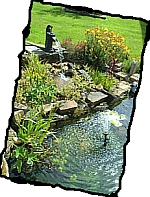 weak. And the concept of “aesthetically pleasing” is a concept unknown to nature. We homeowners,
on the other hand, want all of our plants to survive and thrive–strong and weak, hand in hand singing Kumbaya
as the focal-point birch clump sways us gently on hammocks, our lips stained with Kool-Aid. And when we open
our eyes from that August nap, we want to see rolling, flowing waves of plant life and envious neighbors. It’s
not going to happen without a plan.
weak. And the concept of “aesthetically pleasing” is a concept unknown to nature. We homeowners,
on the other hand, want all of our plants to survive and thrive–strong and weak, hand in hand singing Kumbaya
as the focal-point birch clump sways us gently on hammocks, our lips stained with Kool-Aid. And when we open
our eyes from that August nap, we want to see rolling, flowing waves of plant life and envious neighbors. It’s
not going to happen without a plan.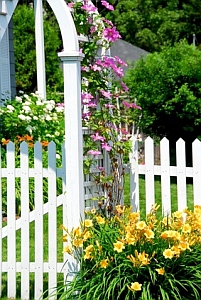 gleaming smile, and a detailed dissertation of each plant.
 by Better Homes
and Gardens is quite good. 408 pages of all new material, this guide has over 700 photographs and 100 complete
step-by-step projects ranging from handling slopes to building decks and patios. Plus a huge plant
encyclopedia with 95 photos.
by Better Homes
and Gardens is quite good. 408 pages of all new material, this guide has over 700 photographs and 100 complete
step-by-step projects ranging from handling slopes to building decks and patios. Plus a huge plant
encyclopedia with 95 photos.  . This is a
powerful software package from the trusted folks at Better Homes and Gardens that puts every imaginable tool
at your fingertips for designing outdoor projects from landscaping to decks and patios, sprinkler systems,
water features, etc. You can import your own photos, choose and arrange plants from a catalog of over 3500,
and estimate project costs. This is great stuff for experimenting with design ideas--see what a
single or multi-level deck would look like coming off your back door; see what a brick or stone patio would
look like before you break your back; build fencing and arrange outdoor furniture in 3D graphics.
. This is a
powerful software package from the trusted folks at Better Homes and Gardens that puts every imaginable tool
at your fingertips for designing outdoor projects from landscaping to decks and patios, sprinkler systems,
water features, etc. You can import your own photos, choose and arrange plants from a catalog of over 3500,
and estimate project costs. This is great stuff for experimenting with design ideas--see what a
single or multi-level deck would look like coming off your back door; see what a brick or stone patio would
look like before you break your back; build fencing and arrange outdoor furniture in 3D graphics.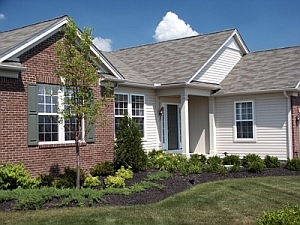 digging up all three because they had collectively
outgrown the flower bed. I threw’em in the ground along the back fence and now they’re trying to push the
fence down. No offense to you Blue Pfitzer propagators, but your junipers are brutal.
digging up all three because they had collectively
outgrown the flower bed. I threw’em in the ground along the back fence and now they’re trying to push the
fence down. No offense to you Blue Pfitzer propagators, but your junipers are brutal.
 Back To
Top
Back To
Top
|
PlanningLandscaping.com
Your growing online source for landscape
planning -- from the sketch pad of garden plans and
outdoor structures, to plant selection, planting tips,
and thoughts and recommendations on outdoor
furnishings.
© Copyright 2008 - Present, Webstreet Properties. All Rights
Reserved.